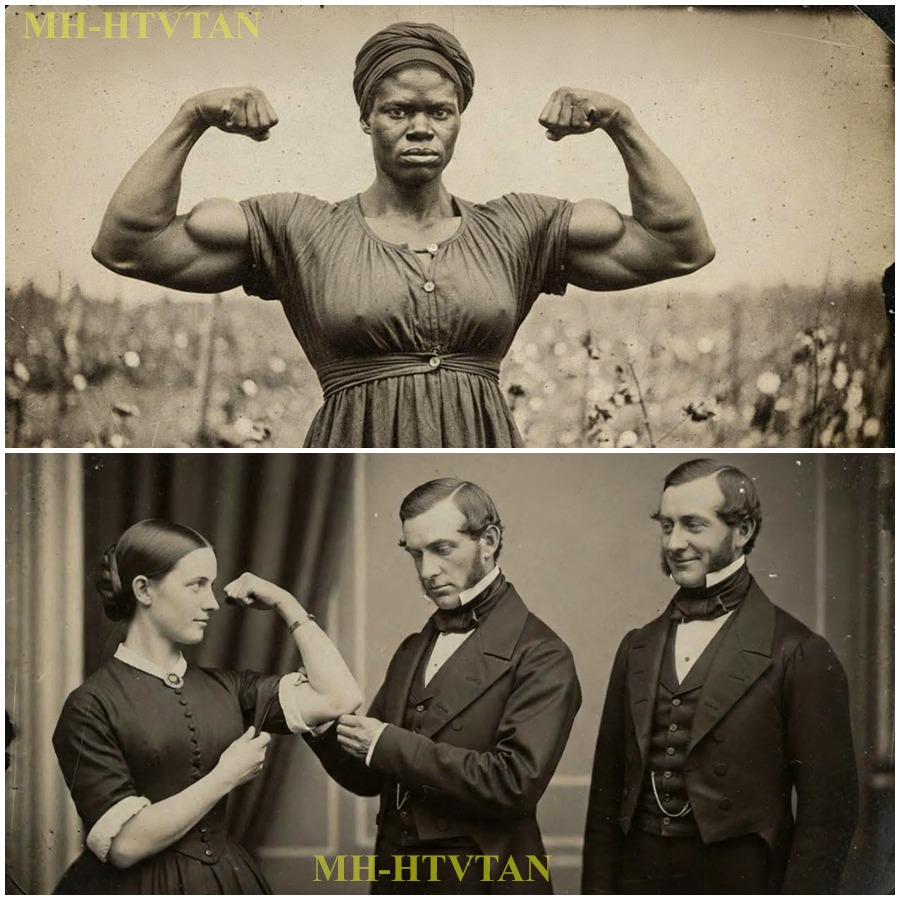
Peton so profoundly. The baby was born on a humid August morning, when Charleston’s heat made everything feel oppressive and heavy. The birth took place in a small wooden structure that served as Ravenswood’s birthing room, attended by an elderly midwife named Patients, who delivered hundreds of babies over four decades, and who’d learned to hide her sorrow at bringing children into a world where they would be owned and controlled from their first breath.
Coutura labored through the night and into morning, finally delivering just after dawn as light filtered through gaps in the wooden walls. The baby was unusually large, measuring 24 in long with a weight of 9 lb. Proportions that immediately signaled she was developing according to the genetic patterns Cornelius Ashford had spent years trying to cultivate.
Cornelius was notified immediately and arrived at the birthing room within an hour, accompanied by his chief overseer, a man named Edmund Vale, who kept detailed records for the breeding program. They measured the infant with the same clinical attention used for valuable livestock, recording dimensions, noting the proportional length of her limbs, examining her bone structure for signs of the robust development they’ projected based on her parents’ characteristics.
Cornelius assigned the baby her designation, specimen 41, marking her as the 41st child born into the breeding program since he’d taken control of Ravenswood. The number would follow her throughout her life, appearing in every record, every evaluation, every projection about her future use. Coutura wanted to name her daughter Ruth after a biblical figure who’d shown loyalty and courage in the face of exile and loss.
But that name never appeared in official plantation records. To Cornelius and his administrative apparatus, the baby was simply 41, a data point representing potential validation of theories about human breeding. The extra food rations began immediately. Cornelius ordered that Coutura receive portions of salt, pork, cornmeal, beans, and vegetables that exceeded standard allotments, ensuring optimal nutrition during nursing to maximize the infant’s early growth.
This created immediate tensions in the quarters where food was already scarce and distributed in carefully measured amounts designed to maintain work capacity without promoting health or strength beyond what benefited the plantation’s productivity. Some people resented the special treatment, seeing it as favoritism that came at their expense when the plantation’s overall food supply remained fixed.
Others understood that the extra rations were a poisoned gift, coming with expectations and control that would make Ruth’s life fundamentally different from normal enslavement’s already unbearable conditions. Patience. The midwife, who delivered Ruth, tried to help Coutura navigate the complicated social dynamics the extra rations created.
She advised discretion, suggested sharing portions with others to build community support rather than resentment, and warned that Ruth would face unique challenges as she grew. The child would need the community’s protection and solidarity, and alienating people through perceived privilege, even involuntary privilege imposed by owners, would make survival more difficult for both mother and daughter.
Coutura followed this advice as carefully as she could, maintaining relationships with other women in the quarters, sharing what extra food she dared, and trying to raise Ruth with some semblance of normal childhood, despite the constant surveillance that characterized every stage of the girl’s development. Ruth’s early years were defined by being constantly observed and measured.
Edmund Vale kept detailed journals documenting her growth and entries from 1838 through 1842 read like livestock breeding records noting every developmental milestone with clinical precision but no acknowledgement of human experience or emotion. Ruth at 3 months shows 15% greater muscle mass in limbs compared to average infants. Mother’s nutrition adequate.
Recommend maintaining enhanced rations. Ruth at 8 months demonstrates advanced motor control, pulling to standing position earlier than typical development timeline. Father’s height genetics apparently expressed, projecting adult height of 6’2 in to 6’4 in. Ruth at 12 months walking unassisted, showing grip strength approximately double that of average children her age.
recommend continued monitoring and enhanced nutrition through early childhood. Cornelius read these reports with deep satisfaction. Convinced that his breeding program was producing exactly the results, three generations of careful selection should yield, he began showing Ruth off to visitors, even when she was still a toddler, hosting gatherings where plantation owners from across South Carolina and neighboring states came specifically to observe her and hear about Ravenswood’s breeding program. These visits were torture for
Ruth as she grew old enough to understand what was happening. She would be brought out to stand before strange men who discussed her body as if she were livestock, evaluated her measurements against their own enslaved populations, and debated whether implementing similar programs on their plantations would yield sufficient returns to justify the investment.
Ruth learned from these exhibitions that she was not seen as fully human by the men who controlled every aspect of her life, and this knowledge shaped her understanding of the world. in ways that would have profound consequences years later. By age 5, Ruth stood 3 feet 11 in tall, significantly above average for her age with proportional muscular development that made her appear even more unusual.
Her arms and legs were longer than typical children’s proportions, giving her a gangly appearance that suggested she would eventually achieve the exceptional height Cornelius projected in his journals. Her body showed definition in the shoulder and back muscles that typically didn’t appear until adolescence, and her grip strength was remarkable enough that Veil documented her ability to hold weights that children twice her age struggled with.
But measurements didn’t capture Ruth’s psychological development, which was equally exceptional, though for reasons Cornelius never fully understood. Ruth absorbed everything around her with intense focus, learning to read situations and people’s moods with uncanny accuracy. She understood by age five that she was constantly being evaluated, that her body was property more valuable than most, and that this value made her both protected and trapped in ways other enslaved children weren’t. She learned to mask her
thoughts, presenting a blank face to white observers. While fury and awareness built inside her like pressure in a sealed container, she learned the dual consciousness required for survival, being who she needed to be for those who owned her while preserving some inner self that remained separate from their control.
Coutura taught Ruth as much as she could about their family history, about a Benny who’d been Ruth’s grandmother, about the fact that their unusual size and strength came from West African heritage where women had been tall and powerful before being captured and commodified. These conversations gave Ruth a framework for understanding herself that differed radically from Cornelius Ashford’s narrative of successful breeding.
Where Cornelia saw genetic improvement through selective pairing, Coutura taught Ruth to see inherited strength from ancestors who’d been free, characteristics that belonged to her rather than being created by the Ashford’s program. Patience also played a crucial role in Ruth’s early development. The elderly midwife had delivered Ruth, had watched her grow, and had recognized early that this child possessed not just physical exceptionality, but intelligence and awareness that would make her either a leader or a martyr, depending on how
circumstances unfolded. Patience taught Ruth about Charleston’s history of slave resistance, about Denmark V’s planned uprising in 1822 that had been betrayed before it could begin, about the constant undercurrent of rebellion that existed even when it couldn’t be expressed openly. She taught Ruth to be patient, to survive, to wait for opportunities rather than acting from anger in ways that would get her killed without achieving anything meaningful.
By age seven, Ruth was put to work at tasks specifically designed to build her physical capabilities further. She carried loads of rice from fields to processing areas, developing her back and leg muscles. She lifted heavy barrels, building upper body strength. She performed labor that would typically be assigned to adolescent boys, and she managed it adequately despite her young age.
Cornelius watched this progress with pride that bordered on obsession, documenting every achievement as further evidence that his breeding program could produce superior workers who would ultimately generate enormous profits through both their labor and their value in breeding future generations. The quarters at Ravenswood had developed their own distinct culture over decades, maintaining elements of West African traditions that had survived the Middle Passage and slavery’s attempts to erase cultural identity.
People spoke gula, a creole language, blending English with African linguistic patterns that allowed conversations white observers couldn’t fully understand. They cooked traditional foods when possible, maintained spiritual practices that incorporated African beliefs, and created tight-knit communities that provided emotional support in a world designed to break their spirits.
Ruth grew up embedded in this culture, learning its codes and patterns, understanding how resistance operated through subtle acts that flew beneath overseers notice. She learned which songs carried coded messages, how information moved through seemingly casual conversations, and which people could be trusted with dangerous knowledge.
This education prepared her for roles she couldn’t yet imagine, but would eventually need to fill. Among the enslaved population at Ravenswood were natural leaders who commanded respect through wisdom, courage, or spiritual authority. One such person was a man named Gabriel, 48 years old in 1843, who’d been born in Charleston and survived conditions that had killed many others.
Gabriel worked as a blacksmith, a skilled position that gave him slightly more autonomy than field workers received, and he used that position to maintain awareness of everything happening on the plantation and in Charleston beyond. Gabriel had connections throughout the city’s enslaved community, relationships built over decades that allowed information to flow between plantations and urban households.
He knew which ship captains might be sympathetic to fugitives, which white abolitionists existed in Charleston despite the risk such beliefs created, and which routes through the Low Country offered the best chances for successful escape. More importantly, Gabriel understood how to read the political and social currents that shaped slavery’s evolution.
And by 1843, he was increasingly convinced that significant changes were approaching, though what form those changes would take remained uncertain. Gabriel watched Ruth’s development with particular attention. He saw in her not just exceptional physical capabilities, but potential for leadership that could be channeled productively if circumstances allowed.
He began teaching Ruth things that went far beyond what Cornelius’s program intended, subtle lessons about power and resistance, disguised as ordinary conversations. He taught her about leverage, both literal and metaphorical, about how strength could be applied efficiently rather than wastefully. About how understanding systems allowed you to find their vulnerabilities.
He taught her to think strategically, to evaluate long-term consequences rather than acting impulsively, and to recognize that sometimes the most powerful resistance looked like patience and preparation rather than direct confrontation. By age 10, Ruth had internalized these lessons alongside Cornelius’s constant measurements and evaluations.
She performed her assigned labor without visible resistance, submitted to Vale’s documentation without complaint, and maintained a facade of compliance that masked growing awareness and carefully controlled rage. But privately she was preparing for something, though what exactly even she couldn’t fully articulate yet.
She watched everything, remembered everything, and waited for circumstances that might create opportunities for action. Ruth’s measurements at age 10 documented systematic physical development that exceeded even Cornelius’s optimistic projections. She stood 5’5 in tall with measurements that approached those of adult women.
Her chest measured 36 in around, her arms measured 13 in in circumference, and her shoulders spanned 20 in across. She could lift loads that grown men struggled with, and Cornelius documented these achievements with satisfaction that completely ignored Ruth’s humanity or psychological experience. He’d begun showing her off more frequently to visiting plantation owners, and these exhibitions became regular events where Ruth was made to demonstrate her strength by lifting heavy objects, carrying multiple rice sacks simultaneously, and performing
feats that amazed observers who’d never witnessed such capabilities in any woman, or even in most men. The visitors reactions ranged from impressed to skeptical to disturbed, but most saw potential financial applications if Ravenswood’s breeding program principles could be replicated on their own properties.
Cornelius encouraged this interest, sharing his methods openly and discussing how coordinated breeding programs across multiple plantations could produce an enhanced population of workers who would be more productive and therefore more profitable. He envisioned a future where plantation owners throughout the south participated in systematic breeding networks, sharing information and selectively trading individuals to maximize desired traits across regions.
The years between 1840 and 1843 marked Ruth’s transformation from a physically precocious child into an adolescent whose development continued exceeding projections. By age 13, she’d reached 5′ 11 in in height, matching her grandmother, A Benny’s unusual stature and approaching what would eventually be her full adult height.
Her body showed muscular definition that was extraordinary for any adolescent and virtually unprecedented in young women. Her measurements during this period documented development that Vale described in his journals as representing the breeding program’s successful culmination. Ruth’s chest measured 42 in around at age 13.
Her arms measured 16 in in circumference. Her shoulders spanned 22 in across and her thighs measured 26 in around. These numbers appeared constantly in Veil’s documentation, always accompanied by observations about work capacity, physical capabilities, and breeding potential that treated Ruth as valuable property rather than a human being with thoughts, feelings, and awareness of what was being done to her.
But numbers couldn’t capture what it meant to inhabit Ruth’s body and mind during these years. She understood by now that her physical capabilities were precisely what made her valuable and therefore imprisoned. She was too important to Cornelius’s validation of his life’s work to ever be free through conventional means.
She recognized that Cornelius had already begun planning her reproductive future, identifying male children in the breeding program who would be appropriate matches when they reached maturity, treating her future children as already predetermined elements in his multigenerational experiment. Ruth was aware of these plans because information moved through the quarters in sophisticated ways that white observers never fully understood.
Household staff overheard conversations in the main house and shared them. Field workers noticed which young men received extra attention from overseers who were evaluating them for future breeding decisions. People pieced together the larger picture from fragments of information and passed it along through networks built on trust and survival.
Ruth knew exactly what Cornelius intended for her, and the knowledge sat inside her like poison, corroding any possibility of hope or future that she might have tried to maintain. During this period, Ruth was assigned to work in Ravenswood’s rice mill, a massive structure where harvested rice was processed through steps that required constant heavy lifting.
Workers carried 60 lb sacks from storage areas to processing stations, lifted sacks onto tables for sorting, then carried processed rice to wagons for transport to Charleston’s docks. The work was brutal. Performed in heat that regularly exceeded 100° with humidity that made breathing difficult and dust from rice hulls that filled the air, causing lung problems for people who worked there for extended periods.
Ruth worked alongside grown men, many of them selected for mill work specifically because of their size and strength. She outperformed most of them, carrying heavier loads, working longer hours without apparent fatigue, maintaining pace that left others exhausted. The men had complex reactions to this.
Some respected her abilities and treated her as an equal. Others felt threatened or diminished. Most understood that her strength was both impressive and tragic, evidence of what systematic human breeding could accomplish when people were treated as livestock rather than human beings. Cornelius used Ruth’s performance in the rice mill as evidence for his theories, bringing visitors specifically to observe her working.
Per continuare a leggere, clicca su ( SUCCESSIVA 》) qui sotto!