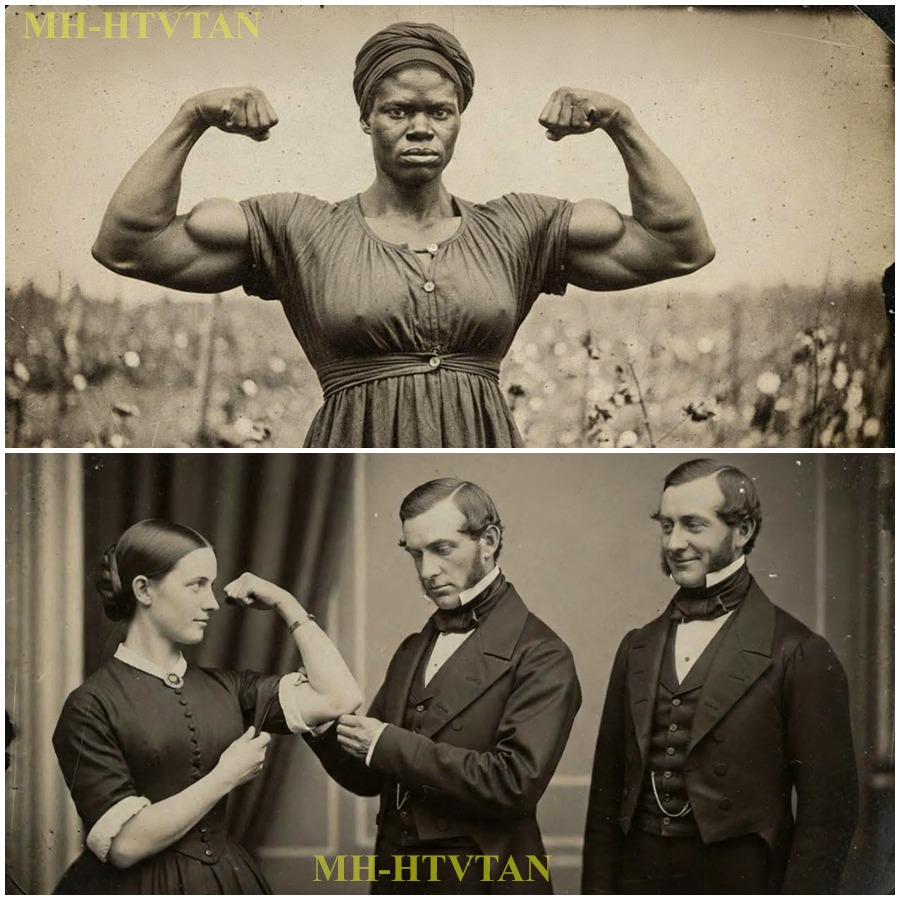
Instead, he was led to a private study where the estate’s owner, a man named Cornelius Ashford, presented him with a leatherbound medical journal and asked a single question that would haunt Peton for the rest of his life.
Can a human being be bred like livestock across generations to enhance specific physical traits? The journal contained measurements taken over 26 years documenting three generations of systematic human breeding. Height, weight, bone density, muscle circumference, carrying capacity, resistance to disease.
Every metric recorded with scientific precision. But what disturbed Peton most deeply wasn’t the measurements themselves. It was the photograph tucked between the journal’s final pages. a dagger type showing a woman whose physical dimensions seemed to defy natural human development. She stood beside a doorframe for scale, her head nearly touching the top of the frame at what must have been 6’3 in.
Her shoulders were so broad they appeared distorted in the image, and her arms showed muscular definition that Peton had never witnessed in any woman or in most men. The photograph subject was identified only by a number, specimen 41. And according to Ashford’s journal, she represented the culmination of an experiment that had consumed his family’s resources and moral boundaries for more than a quarter century. Dr.
Peton left Ravenswood estate that morning without examining any patient, carrying instead a burden of knowledge he hadn’t sought and couldn’t easily ignore.
He returned to his Charleston practice on Meeting Street, and tried to resume normal work, but the image of that woman, the calculations in that journal, the casual way Ashford had presented systematic human breeding as scientific achievement rather than moral abomination.
All of it lingered in his thoughts like a fever he couldn’t break. Pembbertton kept detailed personal diaries throughout his career, and his entries from April through June of 1843 reveal a man wrestling with what he’d witnessed.
He wrote about the conflict between his medical training, which taught him to view human bodies as subjects for scientific study and his religious beliefs, which insisted that human beings possessed inherent dignity that couldn’t be reduced to physical measurements.
He questioned whether he had any obligation to report what he’d seen, though to whom and under what authority remained unclear, since Ashford had broken no laws that Charleston’s courts would recognize.
The practice of breeding enslaved people for specific traits wasn’t illegal in South Carolina, wasn’t even particularly unusual, though most plantation owners conducted such programs with less systematic documentation, and certainly without inviting physicians to review their methods.
What made Ashford’s program distinctive wasn’t its cruelty, which was typical of slavery’s broader system, but its scientific approach and its spectacular success in achieving exactly what it set out to accomplish.
Peton’s diaries note that he’d encountered other breeding programs during his medical practice, had been called to plantations to assist with difficult births or treat injuries, and had witnessed how enslaved people were paired according to owners preferences rather than their own choices.
But Ashford’s program operated on a different scale entirely with three generations of careful selection producing results that seem to push the boundaries of normal human physical development.
The woman in the photograph, Specimen 41, was the program’s masterpiece, and Pembbertton couldn’t stop thinking about what her existence meant, what it revealed about the capacity for human cruelty when justified through scientific reasoning, and what it suggested about the enslaved people themselves who’d endured this systematic violation of their reproductive lives while somehow maintaining enough humanity to survive psychologically.
Peetton eventually made copies of certain pages from Ashford’s journal before returning the original, telling himself that documentation was a form of bearing witness, that even if he couldn’t stop what was happening, he could at least preserve evidence of what had been done.
Those copies survived in Pembbertton’s personal papers, which were donated to the South Carolina Historical Society after his death in 1878. The papers remained largely unexamined until 1962 when a graduate student researching antibbellum medical practices discovered them and recognized their significance. The copies included measurements, breeding pairings, and projections for future generations, but they also included something Peton added himself after visiting Ravenswood multiple times during the summer of 1843.
his own observations of specimen 41, whom he learned was called Ruth, by the people who lived with her in the quarters. Though official records used only her designation number, Peton’s observations paint a portrait that the measurements alone couldn’t capture. He described Ruth as possessing not just unusual size and strength, but an intelligence and awareness that made her constantly watchful, as if she understood exactly what she represented and what her existence meant within the broader system of slavery. He noted that
she spoke with careful precision, choosing words that revealed education beyond what most enslaved people received, suggesting someone had taught her to read and think critically, despite the enormous risks such education involved. He observed that other enslaved people at Ravenswood treated her with a complex mixture of respect, protectiveness, and something approaching reverence, as if her physical presence had become a symbol of resistance.
even when she engaged in no overt rebellious acts. Most significantly, Peton recorded that Ruth seemed to be preparing for something, though what exactly he couldn’t determine. She moved with deliberate purpose, observed everything around her with intense focus, and maintained what Peton described as controlled rage, barely concealed beneath a surface of compliance.
To understand Ruth’s story, to comprehend how a human being could be bred for specific traits across three generations and what psychological toll such a program inflicted requires understanding Charleston in the decades leading to 1843 and the particular form slavery took in the Carolina low country. Charleston had built its wealth on rice cultivation, transforming coastal marshlands into productive fields through a labor system that was arguably more brutal than cotton plantation slavery in the deep south. Rice cultivation required workers
to stand in flooded fields for hours, exposed to mosquitoes carrying malaria and yellow fever, their bodies bent under the Carolina sun while performing repetitive tasks that destroyed joints and muscles. The death rate among rice field workers was extraordinarily high with many surviving only a few years after being assigned to field labor.
This created constant demand for new workers and made plantation owners particularly interested in any methods that might produce workers who were stronger, more resistant to disease, and capable of sustained heavy labor. The Ashford family had arrived in South Carolina in 1768, part of the wave of wealthy English families seeking fortunes in colonial America.
They established themselves in Charleston’s merchant class initially trading in rice, indigo, and increasingly enslaved people brought from West Africa and the Caribbean. By 1790, they’d accumulated enough capital to purchase land north of Charleston and establish Ravenswood Plantation, named for the massive live oak trees draped with Spanish moss that gave the property an appearance of natural grandeur masking systematic brutality.
The plantation grew to encompass 2,000 acres of tidal marshland, transformed into rice fields, sustained by the labor of approximately 300 enslaved people who lived in wooden quarters that leaked during frequent rains and baked during summer months when Carolina humidity made breathing feel like drowning slowly.
Cornelius Ashford’s grandfather, William Ashford, had managed Ravenswood from 1790 until his death in 1815, operating it as a typical rice plantation with typical cruelty. But William’s son, Cornelius’s father, a man named Harrison Ashford, had different ambitions. Harrison had studied at the College of Charleston and developed interests that blended emerging scientific thinking with plantation management.
He’d read about animal breeding programs in England, studied agricultural journals discussing crop improvement through selective seed selection, and become fascinated by whether similar principles could be applied to human beings. This wasn’t original thinking. Plantation owners throughout the South had long practiced informal breeding, pairing enslaved people based on physical characteristics, and breaking apart families that didn’t produce desired results.
But Harrison wanted to approach it systematically to document everything to prove that human beings could be improved through careful genetic selection just like horses or cattle. Harrison began his breeding program in 1817, 2 years after inheriting Ravenswood. He started by surveying the entire enslaved population, measuring everyone, noting physical characteristics, tracking family relationships, and identifying individuals who possess traits he considered valuable.
He was particularly interested in height, muscular development, bone structure, and what he called constitutional vigor, meaning the ability to withstand disease and harsh conditions without succumbing. He created detailed records for each person, assigning them numbers rather than using the names they’d been given by their families or communities.
This numerical system was deliberate dehumanization, a way of transforming people into data points in an experiment that treated human reproduction as agricultural science. Harrison’s program operated through forced pairings. He would select two people based on their physical characteristics and order them to form partnerships, separating existing couples if they didn’t meet his criteria and punishing anyone who resisted.
Children born from these forced unions were evaluated constantly, measured starting in infancy, tracked through development, and either incorporated into future breeding plans if they showed desired traits or sold away to other plantations if they failed to meet expectations. The cruelty of this system compounded across years and generations.
Families were torn apart not once but repeatedly as children were sold or redistributed based on their physical development. Women were forced into partnerships with men they didn’t choose. Their reproductive lives controlled as completely as their labor. Men were evaluated like breeding stock valued for genetic contribution rather than any human qualities.
And all of this was documented in Harrison’s journals with clinical precision that treated systematic dehumanization as scientific progress. Harrison died in 1831, but not before establishing the foundations that his son Cornelius would expand. Harrison had identified several family lines within Ravenswood’s enslaved population that consistently produced children with desired physical traits, particularly unusual height and muscular development.
He documented these lines across two generations, creating what he believed was proof that human breeding could produce measurable improvements in strength and size. Cornelius inherited both the plantation and the obsession in 1831. He was 24 years old, recently graduated from South Carolina College, and determined to prove his father’s theories correct through even more rigorous methodology.
Cornelius expanded the breeding program significantly, hiring overseers specifically to help with documentation and monitoring. He created a classification system that ranked every enslaved person at Ravenswood according to their breeding value with the highest ranked individuals receiving better food rations and lighter work assignments to maximize their reproductive potential.
He developed projections for future generations, calculating how many years would be required to produce individuals with specific physical characteristics and planning breeding pairs decades in advance. His journals from this period read like agricultural breeding manuals, discussing genetic inheritance with the same language used for livestock improvement, as if the people he was manipulating were merely biological material rather than human beings with inner lives, emotions, and relationships. Among the family lines
Harrison had identified as most promising was one that traced back to a woman who’d been brought from Jamaica in 1800. The records identified her only as subject seven, though her descendants would later say her name was Abeni, a Yoruba name meaning we prayed for her arrival. A Beni stood 5′ 11 in tall, extraordinary for a woman of that era, and possessed unusual physical strength that made her valuable for heavy labor.
She’d been purchased specifically because of these characteristics brought from Jamaica, where breeding programs had operated longer than in mainland American colonies, creating populations of enslaved people who were systematically selected for size and strength across multiple generations. A Benny was paired with a man identified in records as subject 12, whose actual name was Samuel, who stood 6’4 in tall and had been born on a Virginia plantation before being sold to South Carolina. Their union was forced,
arranged by Harrison Ashford based solely on their physical characteristics without regard for their own preferences or feelings. A Benny gave birth to a daughter in 1818, a girl who would be designated subject 23 in the breeding records, but whom a Benny named Coutura, meaning incense or sacrifice.
Coutura inherited her mother’s height, reaching 6 ft by age 15, and showed the muscular development Harrison had hoped for. She became a centerpiece of his breeding program, monitored constantly, measured regularly, and eventually paired with another carefully selected man. When she reached what Harrison determined was optimal breeding age, Coutura was forced into partnership with a man designated subject 19, whose name was Daniel, who’d been born on Ravenswood and stood 6’2 in tall with shoulders that spanned 23 in
across. Daniel had been selected for the breeding program as a child, raised with extra rations to maximize his growth and trained for tasks that would develop his strength. He and Coutura produced a daughter in 1838, and this child would become Specimen 41, the woman whose photograph would eventually disturb Dr.
Per continuare a leggere, clicca su ( SUCCESSIVA 》) qui sotto!